Biowaste Credit Stack—Article 2
Every actor in the waste supply chain is making a rational decision—and the vast majority of them lead to sending valuable organic waste to a local landfill. Organic waste, or biowaste, represents approximately 50% of global waste; it is nearly 100% recyclable, and yet less than 5% is biologically treated.
The challenge with the circular economy is not technology; it is a lack of services, participation and economic incentives. The solutions for recycling organic waste—composting, anaerobic digestion (biogas), and insect and microbial processing—are proven and available today. They turn biowaste (e.g., food waste, park & garden waste and other biomaterials) into fertilizer, green power, and proteins—solutions that prevent roughly a quarter (25%) of total global methane production, a greenhouse gas responsible for an estimated one-third (33%) of current warming. The challenge is building the infrastructure and services for biowaste treatment at scale, maintaining it, and incentivizing proper sorting behavior.
Today, unfortunately, no individual actor in the waste supply chain has an economic incentive to participate—in fact, they encourage the opposite.
Think about what happens at a restaurant. Separating food waste takes effort, and more effort equates to added costs. Composting services, where they exist, are more expensive than landfilling tipping fees, and they are always pitted against free municipal hauling—just put the bags out onto the street, and they miraculously disappear. The bio-recycling industry simply cannot compete on price with the landfill or dump down the road.
“Just put the bags out onto the street and they miraculously disappear.”
This is not a failure of values. It is a failure of market design. The linear economy distributes waste disposal costs uniformly across taxpayers, and that flat fee structure gives no individual participant an incentive to reduce waste, sort it, or invest in high-performance recycling solutions—while sustaining a failed linear model.
The circular economy requires coordinated action from every actor in the chain.
Financial Incentives That Reach Every Actor
At COP30 in Belém last year and in the Trellis article earlier this year, I laid out a financing and policy roadmap for biowaste that can introduce new revenue streams in the waste economy through carbon finance and food EPR (Extended Producer Responsibility) schemes by transforming recycled biomass and prevented methane emissions into public goods (carbon credits and recycling credits). A follow-on article described the Biowaste Credit Stack, the credit mechanisms that can unlock catalytic climate capital and accelerate the introduction of EPR regulation globally, expanding producer participation in the market as part of a success-based reward mechanism that can pull demand for services and investment.
However, a financing mechanism is only as useful as its ability to reach the stakeholders who actually need it and make decisions; otherwise, it becomes simply feel-good payments to an industry that does not evolve into a durable, sustainable market. And the critical decision in waste management happens at the source—at the restaurant, the factory, or the household where waste is created—where someone decides whether to separate organics and send them to recycling or throw everything into a single bin.
Current recycling infrastructure schemes like those set up by Producer Responsibility Organizations (PROs)—sector-specific corporate groups who come together to fund local market-based EPR schemes—rarely meet agreed-upon targets. They blame consumers and market dysfunction, and most fail to share data with the public, making oversight impossible. The fact is that the incentives are not properly aligned—the organizations serve as lobbying fronts to commit as little as possible to increasing their financial responsibility. Data and oversight need to be managed publicly, not in silos. The solution is market-based mechanisms with public data sharing.
Unfortunately, market-based EPR programs, including those in Brazil and the UK, also face early-development challenges. These programs are designed only to reward the final operator along the waste value chain, the recycler (or its representative), and they assume that the benefit will somehow trickle down the supply chain to the waste generator for improved sorting. This approach has also proven ineffective and even led to a black market for traded recycled material sales receipts, which has resulted in overcrediting and increased distrust in the market, similar to what we see in the carbon market.
The Circular Economy Needs Full Digitization
What the circular economy actually needs is full digitization of material recovery supply chains, tracking of the chain of custody of waste all the way down to the source of waste creation (the waste generator). This enables the key unlock: rewarding verified recycling behavior financially in a manner that encourages others to participate. The sharing of proceeds generated from verified carbon and food waste EPR credits can change the economics of the services industry—hauling, processing and recycling—attracting new investment and driving behavior change by waste generators who can be financially rewarded for contracting high-performance bio-recycling services.
As identified in the global methane status report, the waste sector is the only methane category that can deliver net savings at the system level, and I believe this approach through traceability and incentives is how we can best seize that opportunity to reduce methane production all over the world, right away. There are many organizations working on waste traceability and incentive design; below I will share how we, at Carrot, are tackling this issue.
How Carrot Is Building Digitization and Rewarding Stakeholders
Mandatory digitization of waste supply chains is already advancing. The EU’s Digital Waste Shipment System (DIWASS) goes live on May 21. Brazil has operated digital waste transfer manifests (MTRs) as legally mandated records since 2021. These systems create a verified record of every commercial waste movement: who generated it, who moved it, where it went, and what waste classification it carries.
Carrot’s Circular Economy Protocol is a digital tracking and Measurement, Reporting and Verification (dMRV) framework that ensures materials are in fact recovered and recycled and turns that public good into carbon credits and recycling credits with full traceability. Every credit is tracked to a series of real-world physical events with identified parties stored in an immutable manner.
The protocol operates in three layers: tracking every waste mass from source to recovery facility in the cloud working with partnering data providers (network integrators); verifying that recycling and GHG emissions prevention actually occurred; and distributing proceeds from credit sales back to every participant who helped make it happen.
At the foundation is the MassID—a unique multiparty-verified digital unit of material assigned to every waste record that enters the system. The MassID records the material type, the weight, and every participant who contributed to its recovery and effective recycling. Where government waste tracking documentation exists, it also checks to ensure the data is accurate—serving as an additional layer of verification.
Carrot’s dMRV auditing system applies verification frameworks—rule sets mapped to approved third-party methodologies—that check supply chain data for each MassID against defined criteria to confirm that diversion, biological treatment, and prevented emissions actually occurred. The dMRV frameworks are developed by the scientific community and published publicly, and the facilities are accredited by independent auditors. 100% of the data must pass the verification rule tests to be eligible for credit issuance, with an additional layer of machine learning for anomaly detection and AI for analysis. This approach significantly enhances the integrity of crediting, while also accelerating the process, lowering costs, and expanding credit issuance from the circular economy. This opens up a new category of circular economy credits in the carbon market, which can be compared to existing landfill gas capture and utilization credits, but with the mission to build a new biowaste treatment industry and drive systemic change. This distinction earned it a new category at AlliedOffsets called “Circularity.”
How It Works
When a MassID passes verification, two independent certificates are issued:
A RecycledID, proving the material was physically recycled at an accredited facility.
A GasID, proving greenhouse gas emissions were prevented by diverting organic waste from landfill to biological treatment.
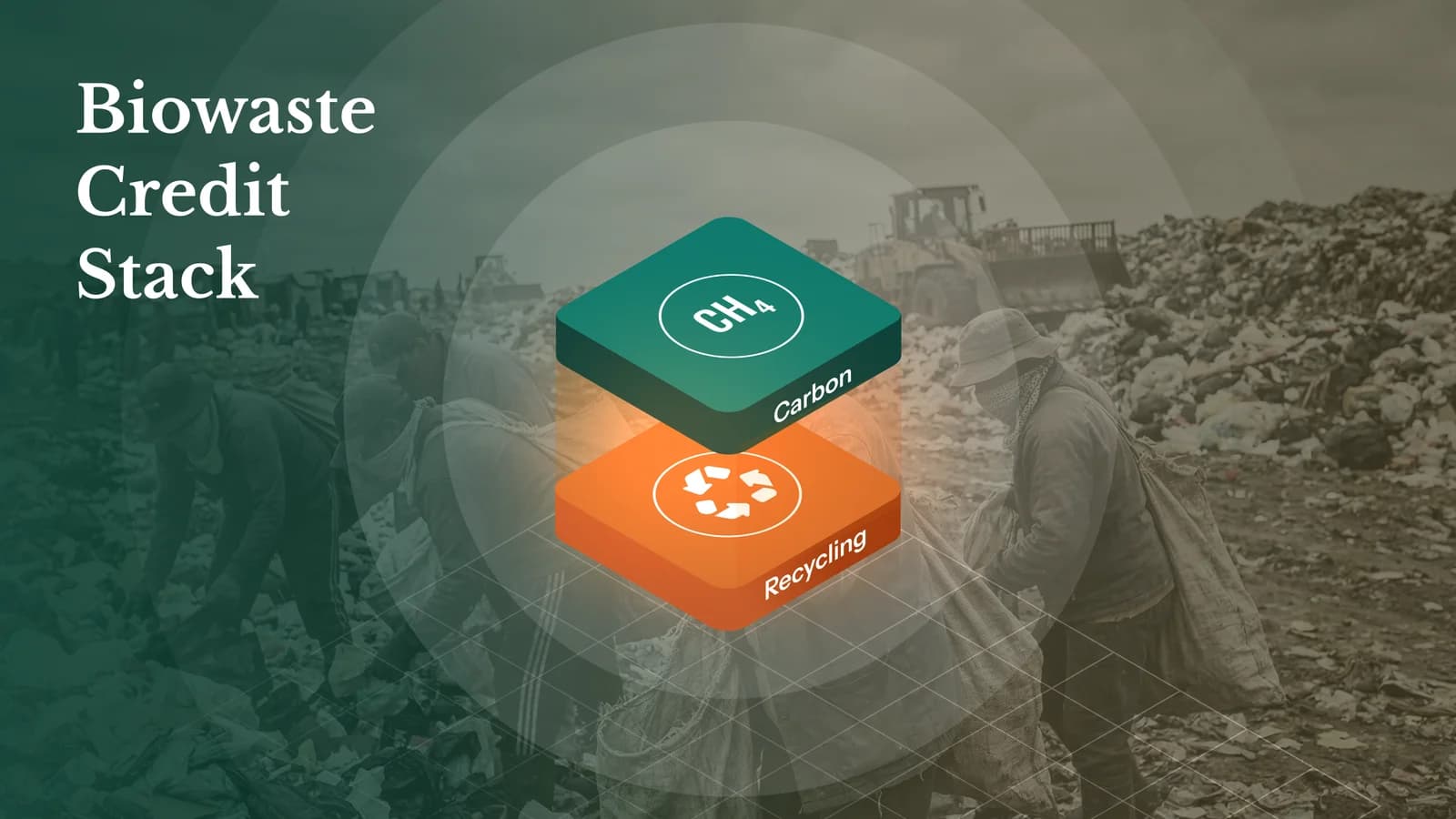
From the same MassID and two certificates, two additional verified environmental credits are issued, each with separate compliance utilities certified using separate methodologies and corresponding dMRV frameworks. The issued credits include: Recycling Credits, where one credit represents one metric ton of verified recycled material, and Carbon Credits, where one credit represents one metric ton of CO₂-equivalent emissions prevented at a landfill. This is the credit stack presented in the prior article, Part 1 of the Biowaste Credit Stack, describing the role of each credit.
Each Recycling Credit and Carbon Credit is traced back to a set of retired MassIDs. When a credit is purchased, the proceeds get split and submitted to all of the individual parties involved, as recorded within each chain of custody logged in each MassID.
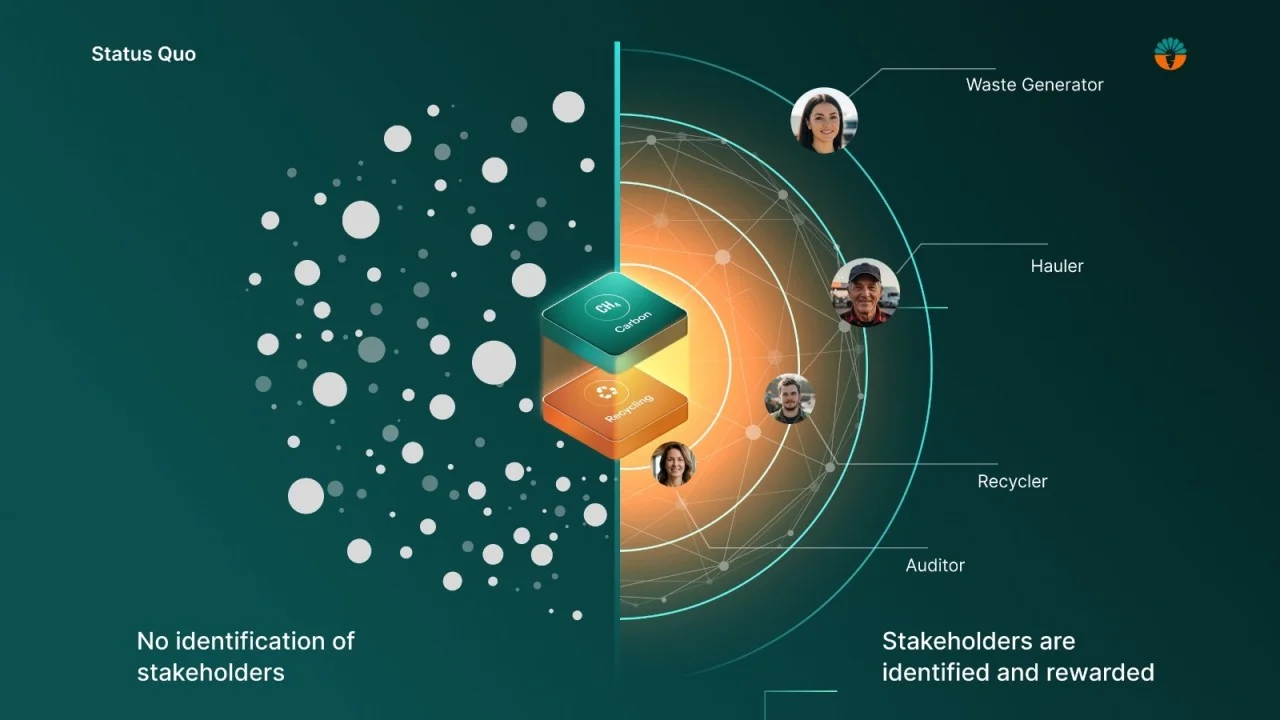
Every participant—the waste generator, the hauler, the processor, the recycler, and the technology providers that participate in the digitized supply chain—has a digital account. Each participant’s share is calculated automatically based on their verified role in the chain of custody recorded in the MassID for the given waste type and region.
The Buyers
- Companies with large methane footprints (technology companies running AI data centers; oil, gas, and petrochemical companies; the cattle industry; and any organization sourcing natural gas or fossil power) pay in through carbon credits.
- Food producers and consumer goods companies pay in through EPR recycling credits.
The proceeds are distributed to every verified participant, creating new revenue streams for service providers while delivering a direct financial reward to waste generators who separate and invest in recycling.
The distribution varies based on individual circumstances. Carrot works with ecosystem partners to develop a Rewards Distribution Policy that governs the percentage splits for each stakeholder category by waste type and can be adapted for local market conditions.
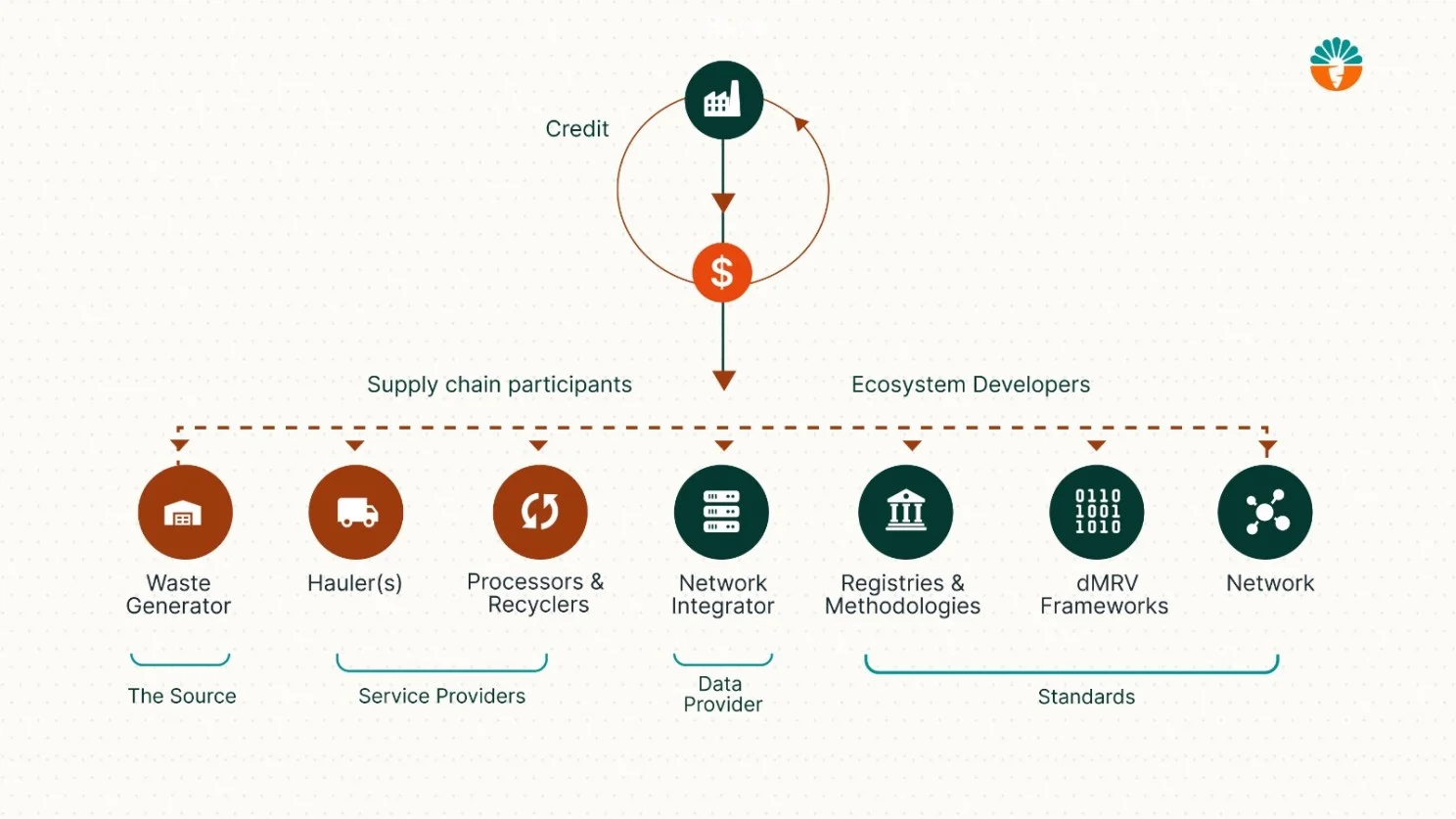
Rewards Distribution from Carbon and Recycling Credit sales on Carrot
For organic waste composting in Brazil, the waste generator receives the largest individual share at 30%, because that is where the sorting decision happens. The recycler receives 20%. The hauler and processor each receive 10%. The ecosystem developers: standards, scientists, auditors, and network receive 30%. These are governed parameters, not fixed rules—designed to optimize resource recovery rates and ensure the largest share reaches the point where behavior change matters most.
When the waste generator is not identified, all other participants receive discounted rewards, and the generator’s share flows to a community impact pool that funds waste management improvements in the local territory. Everyone earns more when the full supply chain is fully visible and data quality is high.
This creates pressure to extend waste tracking all the way to the source—the waste generator—through shared financial interest. And because the policy is tunable, it can be optimized for the specific bottleneck in each geography: generator participation in one market, hauler capacity in another, recycler investment in a third. The goal is to design for outcomes, not uniformity or mandates that can’t be enforced.
The Market Flip
When credit revenue reaches every participant, the market flips.
The green premium—that $50 to $100 per ton cost gap that has kept composting uncompetitive against landfilling in mid-development countries—does not need to be subsidized permanently.
Waste generators sort better because sorting is less expensive. Service providers invest in capacity, because demand is more predictable and growing. New entrants appear—haulers that specialize in organics, community composters that can now access capital through participation in crediting programs, and technology providers that connect logistics data to verification systems.
Better sorting produces higher-quality feedstock, which improves composting economics, which attracts more investment, which extends coverage to more generators. The green premium shrinks—and eventually disappears as the market reaches scale.
Catalytic Financing
This phase is where catalytic carbon capital serves a dual purpose. The carbon credit buyer in Phase 1 funds the infrastructure and the incentive payments. The same investment that builds bio-recycling capacity also funds the rewards distribution that changes behavior at the source. The carbon buyer is not locked in permanently—they are the catalyst. When Food EPR activates in Phase 2, the recycling credit takes over as the durable revenue stream, purchased by the food producers and consumer goods companies that generate the waste in the first place.
System Change Starts at the Source
The waste sector is the only methane-emitting category that can deliver net savings at the system level. Not incremental reductions — net savings. That opportunity is available right now, in every country, at every scale.
The biowaste credit stack—catalytic carbon finance to build the infrastructure, recycling credits to sustain it with Food EPR, and a high-integrity rewards distribution that reaches the waste generator—is how we get there. By making recycling the rational economic choice at every point in the chain.
High-integrity verification. Full supply chain traceability. Proceeds that flow back to the source and change recycling economics.
In the next article, I will show what this process looks like in practice — from a restaurant in Brazil to a composter turning food waste into fertilizer, with named stakeholders, real economics, and the data trail that connects them.
The architecture is here. Now I will show you that it works.