


What is a Recycling Credit?
A certificate representing a specific quantity of waste that has been verified as recycled.
Utility
Extended Producer Responsibility
Carrot's credits are digitally produced, verified and certified and they serve as key instruments in driving behavior and system change toward a low-carbon circular economy.
Organizations need a business-friendly solution to enable them to work with customers and supply chain participants to reduce their fair share of waste and greenhouse emissions produced.
While regulators and municipalities have proven they cannot manage waste, they can create compliance programs that require and incentivize waste and GHG emissions reductions to offload the responsibility of waste management to the private market.
Credits purchased by organizations provide the incentives, 'Carrots,' needed to encourage investment in environmental services and individual participation within an ecosystem solution. Businesses can focus on their core business while efficiently and inexpensively, contributing to waste and carbon reduction through a market-based rewards system.
Purchased and retired credits are used by companies as environmental claims to prove compliance with waste reduction mandates (Extended Producer Responsibility (EPR)) and voluntary and/or mandatory carbon reduction.
A certificate representing a specific quantity of waste that has been verified as recycled.
Utility
Extended Producer Responsibility
A certificate that represents the verified reduction or removal of 1 metric ton of CO₂ equivalent emissions from the atmosphere.
Utility
Carbon Accounting, NetZero
Credits are a market-friendly, incentives-based solution that help businesses, communities and individuals work together to recover and reuse resources—an instrument that can make recycling cheaper than landfilling in every location around the world.
- Ian McKee, Carrot CEO

Certification is incredibly slow, expensive, and bureaucratic. Even when working with reputable auditors and certifiers, certification still raises integrity concerns due to poor verification capabilities, causing sales uncertainty for project developers.
In addition to not using data-driven auditing and verification, project data is stored in private, siloed databases, marketplaces trade credits largely in private transactions, and financial distribution of proceeds cannot be tracked—typically made to a single actor for redistribution.
The market will remain small and 'for the few,' as long as certification is conducted on a project-by-project basis and carbon credits, in particular, are priced in conjunction with their co-benefits. Without credit commoditization, buyers will not enter the market due to lack of available volume (liquidity) and pricing transparency.
Waste is tangible, easily measured and verified, and infinitely recurring, even in an efficient circular economy, making it a solid foundational asset for a green credits market capable of capturing climate finance dollars for global waste and GHG emissions reduction.

Carrot's traceability solutions, combined with digital Measurement, Reporting and Verification technology, utilizing methodologies designed by industry experts, provide a breakthrough in credit creation, reducing certification costs and bureaucracy, while improving speed and expanding access.
Recycling and Reuse produces immediate environmental and societal benefits. They prevent pollution to land, water and the atmosphere, avoid new raw material extraction and biodiversity loss, as well as the needless GHG emissions associated with hauling and processing. Carbon and waste reductions are clearly additional, permanent and non-reversible.
Carrot introduces two key innovations to the credits market: 1) transforms recycling and carbon into commodities so that a high-volume market can be created and that will include everyone, and 2) scale environmental work by accessing a global market of credits while distributing rewards transparently to supply chain participants in a manner that is tailored to local markets.
Carrot introduces two key innovations for the credits markets:
01
Carrot transforms recycling and carbon into commodities so that a high-volume market can be created that is inclusive of everyone.
02
Carrot scales circular economy infrastructure and incentivizes environmental work by accessing a global market for credits that distributes rewards in a transparent and tailored fashion to local communities.
All Carbon credits on Carrot are issued as commodities measured by the carbon equivalent emissions reduced or removed. They do not contain any co-benefits associated with the project that produced them, including social, economic, biodiversity or other. Co-benefits on Carrot remain with an underlying recycling credit, as attributes more accurately pertain to the activity that created it. Each credit is verified and certified according to its own methodology.
Carrot's Credits are tokenized into unique, non-fungible tokens. Retired credits become untransferable and are stored on Ethereum, a public, decentralized blockchain network. Credits and their underlying data can be accessed by any registry directly and used for accounting and/or regulatory compliance verification.
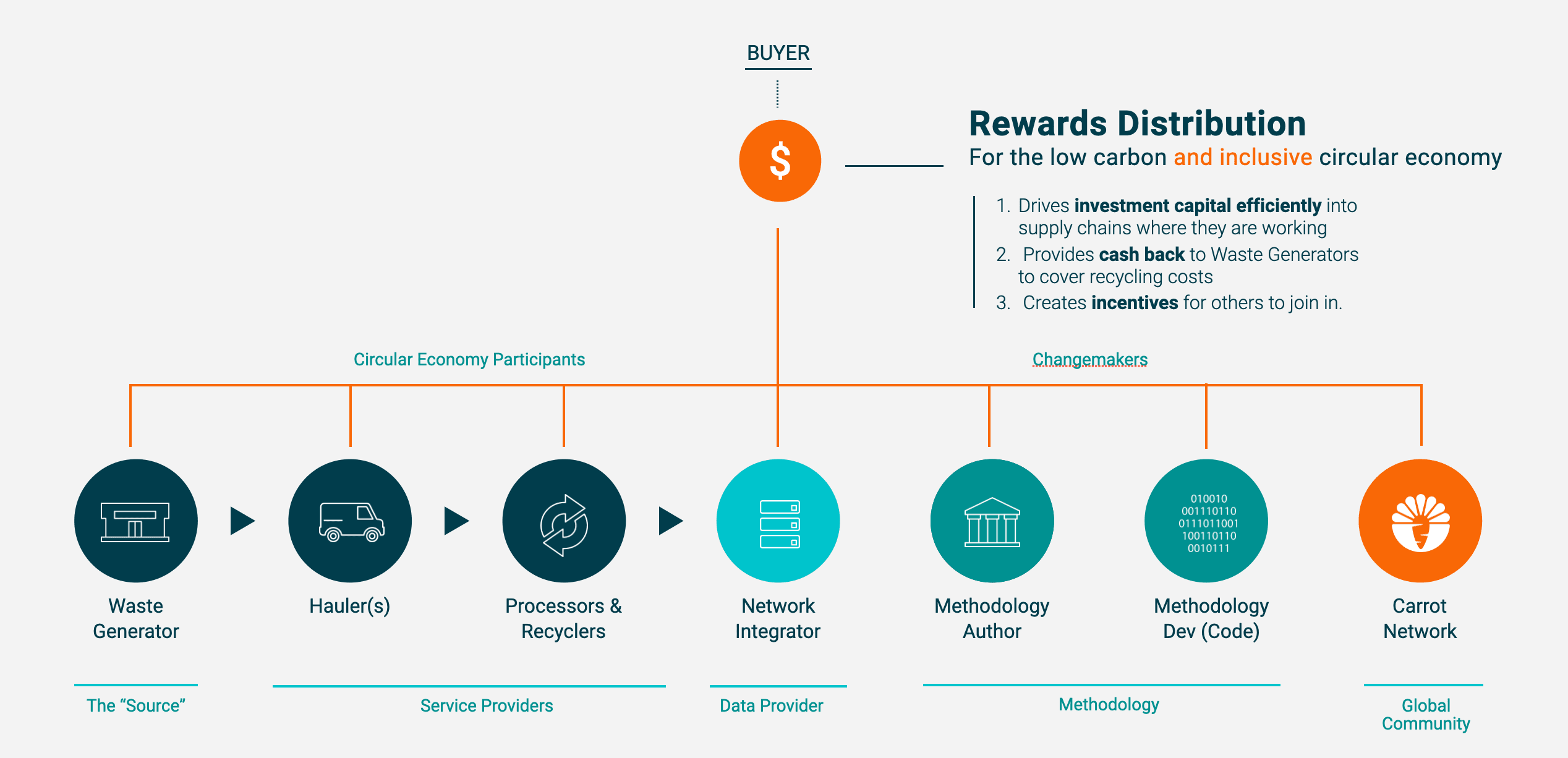
The purchase of credits distributes rewards directly to all of the contributors who created each credit, including waste pickers, haulers, recyclers and processors. This fair and transparent distribution mechanism ensures that the people who create environmental impact are properly compensated.
Learn more about how Carrot encourages supply chain digitization up to the source of waste creation and employs self-policing incentives (Proof-of-Authority) for ensuring quality data is recorded on the network.
Pay-out ratios are determined in partnership with market participants to maximize reuse and recycling rates in a given location, and codified into smart contracts that govern each credit sold. Clarity in how credit proceeds will be distributed helps build trust with market participants, encourages investment while reducing risk, and enables the market to grow.
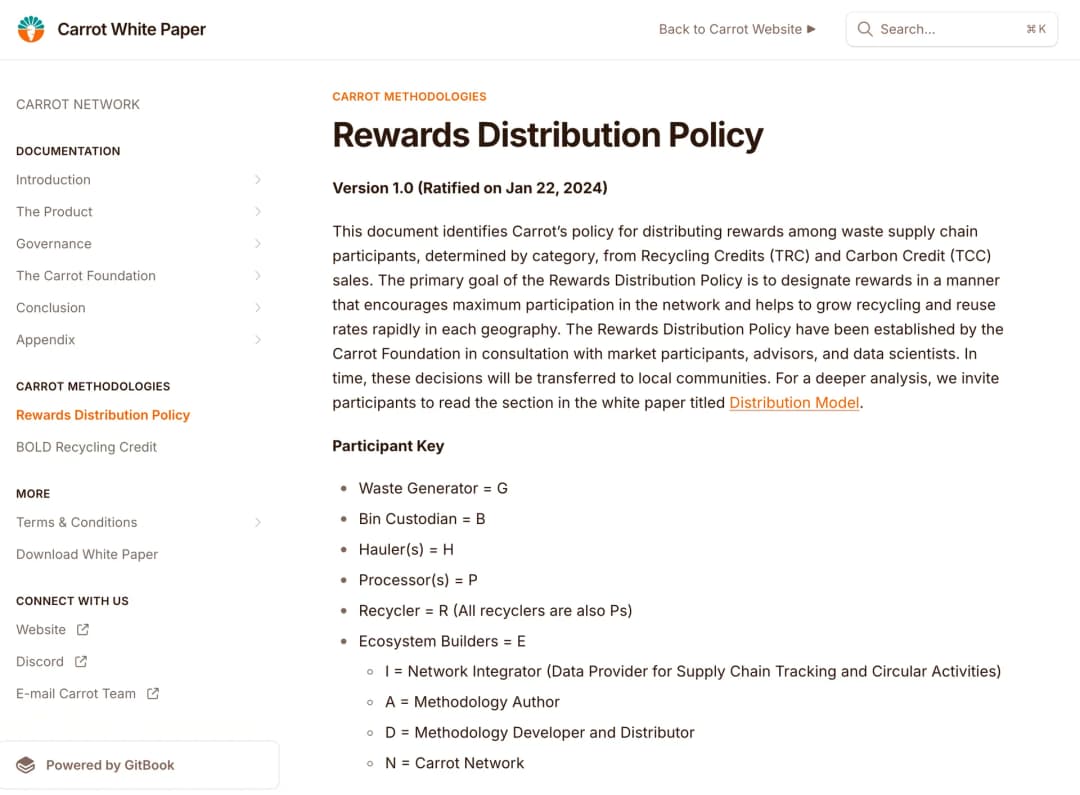
Go to Carrot's "Rewards Distribution Policy."
The credits listed on the Carrot Network are developed by independent dMRV methodology authors, validated and verified by third-party auditors and marketed by their developers. Credits are approved by Carrot's technical committee for platform use.
Author: Caio de Teves Inácio
Developer: Solidos Brasil LTDA
A recycling credit generated from certified-recycled organic waste.
Go To MethodologyAuthor: Caio de Teves Inácio
Developer: Solidos Brasil LTDA
A carbon credit generated from prevented methane emissions at landfills due to the composting organic waste.
Go To MethodologyLaunching Soon
Author: Caio de Teves Inácio
Developer: Solidos Brasil LTDA
A recycling credit generated from certified-recycled plastic waste.
Seeking New dMRV Methodologies
Have a dMRV methodology you want to submit for analysis? Reach out to Carrot. Approved dMRV methodologies share in the economics of the credits that are sold as long as the technology is in use. Seeking recycling dMRV methodologies for: Plastic, Glass, Aluminum, E-Waste, Paper & Cardboard
Submit a dMRV Methodology


